





Hip Thrust, an evolution of the free-body hip extension, is now the must-have exercise for the targeted and in-depth development of the Great Gluteus and posterior chain.
Its uniqueness lies in its ability to generate a very high mechanical tension on the gluteus in the phase of maximum shortening (lockout), distinguishing it from exercises such as the squat.

Biomechanics, Purpose and Functional Strength
The Hip Thrust is a hip extension exercise in closed kinetic chain.
Basic stance and Technical Gesture: This is performed in a semi-sitting position, with the back resting on a raised support (Platform Bench) and the feet firmly on the ground. The overload (barbell) is above the hips. The movement consists of vertical thrust to bring the pelvis in line with the shoulders and knees. The crucial point is the search for the maximum voluntary contraction of the buttocks (the squeeze) at the point of maximum extension, avoiding compensatory hyperextension of the lumbar region.
This specificity makes it essential for:
- The functional strength of the posterior chain.
- The maximisation of power in hip extension (crucial in sports such as sprinting and jumping).
- Accident prevention (e.g. hamstring strains or lumbar problems).

The SIDEA 9122K Kit: Engineering for Performance and Safety
SIDEA, Europe’s leading sports equipment supplier, designed the Hip Thrust 9122K Kit with a focus on maximising performance and absolute safety. Kit 9122K consists of elements with optimised functions:
- Hip Thrust Platform Bench (9122): Equipped with semi-cylindrical padding and sturdy construction, it ensures stabilisation of the trunk and prevents momentum error and hyper-lordosis (arched back).
- Barbell Support (9122/1): Features anti-tip ‘cradle’ recesses, offering maximum safety and facilitating loading/unloading and entry/exit, acting as safety rails.
- Training 140 barbell: Compact and with Olympic construction solutions, it ensures minimum space requirements and maximum reliability for load management.
- Barbell Pad Hip Thrust: Exercise-specific, double-thickness padding provides comfort and protection of the pubic/pelvic area, allowing the use of high loads without pain.
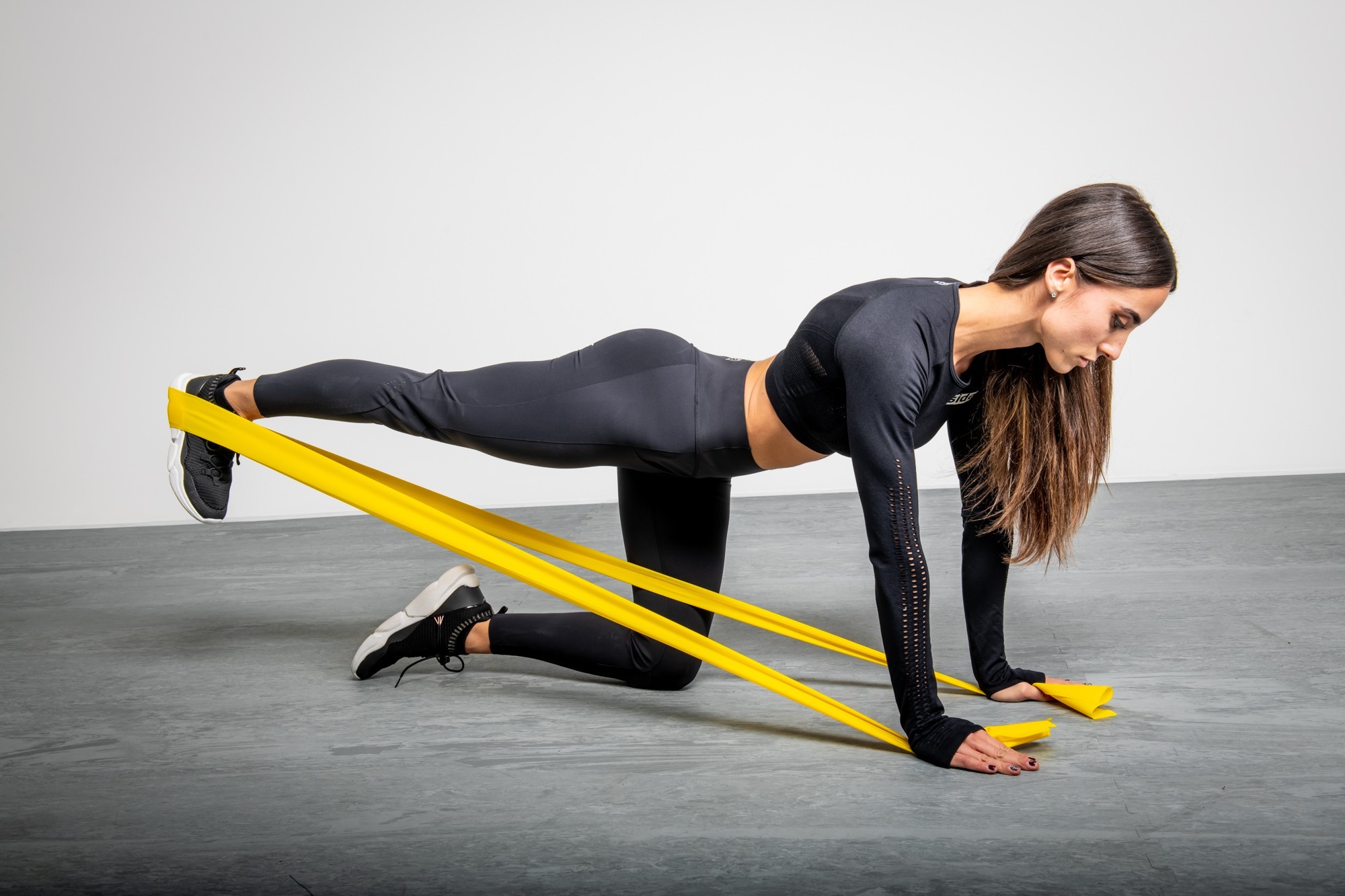
- Hip Band: Adds resistance in abduction, stimulating the gluteus medius and TFL in a complementary manner.
The strategic benefits of this kit lie in the Optimised and Safe Setup, which allows maximum muscle activation and ensures Range of Motion (ROM) management.

Movement Analysis: Correct Execution
Movement analysis: how to perform a hip trhust correctly with the Sidea 9122K kit
The hip trust movement consists of 2 phases: an eccentric phase, during which the pelvis approaches the ground by bending the hip, and a concentric phase, during which the glutes push the overload upwards, extending the hip.
- Set Up: The subject positions him/herself with the back resting on the inclined pad of the hip thrust bench platform, with the feet and heels firmly anchored to the foot-platform, using the hip width as stance.
- Positioning the barbell: The subject positions the Training 140 Barbell Pad on the 9122/1 barbell supports, making sure that the Barbell Pad Hip Thrust is well positioned on the pelvis to avoid pain or pressure points.
- Starting position: The subject starts the movement with hands on the barbell, pulling it off the support and pushing up with the hip, extending it, until the tibia is perpendicular to the ground. Throughout the movement, the core remains active and the back maintains a neutral stance (not hyper-arched).
- Concentric phase: the subject extends the hip upwards (hip extension) until the pelvis is aligned with the shoulders, and maintains the position by voluntarily contracting the buttocks (squeeze phase)
- Eccentric phase: the subject slowly flexes the hip, bringing the pelvis closer to the ground, keeping the feet anchored to the ground, always pursuing a neutral posture of the back.

Common Mistakes & How to Avoid Them
The main problems can be solved with technical focus and the use of the Kit:
- Lumbar Hyper-extension (Hyper Arch): Losing the neutral stance by arching the back. The solution is massive activation of the Deep Core and concentration on the tuck (retroversion) pelvic end. The stability of the SIDEA pad helps prevent this error.
- Knee collapse: Knees collapse inwards. The solution is the use of the Hip Band (included in the SIDEA Kit) over the knees to force a constant push outwards, improving stability.
- Wrong Foot Positioning: Excessive distance or proximity, which shifts the load onto the quadriceps or femurs. The solution is to find the distance that ensures the tibia is perfectly perpendicular to the ground at the top of the movement.
- Excessive Range of Motion (ROM): Excessive lowering that makes the movement unstable. The solution is for SIDEA’s Barbell Support 9122/1 to help you define the correct ROM, avoiding descents that take focus away from the target muscles.

What are the Target Muscles of Hip Thrust?
Main Muscles
- Gluteus Maximus (Great Gluteus) It is primarily responsible for hip extension and works in maximum activation, especially at the end point of the thrust. Electromyographic studies show that the Hip Thrust produces higher activation values than exercises such as squats and lunges, especially in the final portion of the ROM.
- Ischiocrucials (semitendinosus, semimembranosus, biceps femoris) Involved as stabilisers and synergists in the eccentric phase of movement. Although less active than the gluteus maximus, they participate in controlling hip flexion.
Complementary Muscles
- Deep core (transverse abdomen, internal obliques) Responsible for managing intra-abdominal pressure and pelvic stabilisation throughout the movement.
- Gluteus medius and minimus + TFL (tensor fasciae latae)When an elastic band is used above the knees, an abduction component is added, stimulating the entire gluteal muscles more completely.

FAQ(Frequently Asked Question)
- Can I use the hip thrust instead of the squat?
The Hip Thrust is a complementary exercise to the squat, acting more on the target muscles of the posterior chain such as the gluteus maximus. The combination of the two exercises is the best choice.
- How much load should I initially use with KIT 9122k?
The load to be used is subjective depending on the user’s level and experience during the technical execution of the exercise. It is important to perform the exercise with a gradual load in order to refine the execution technique as much as possible.
- Can I use the Bench Platform without the Barbell Supports?
Yes, the 9122/1 supports have been specially designed to provide greater security and convenience during setup. They also help to better manage movement ROM
Sale!

Sale!




The strength of the mind and of movement
Original Club: When Training Becomes an Anthem to Your Uniqueness Sidea (S): I have to [...]
24
Nov
Nov

Home & Garage Fitness
Together we develop your home or garage gymSend us the floor plan of your space [...]
18
Nov
Nov

Hip Thrust: Full Analysis
Hip Thrust, an evolution of the free-body hip extension, is now the must-have exercise for [...]
06
Nov
Nov

Circular Strength: The Training That Anticipated the Future
Strength That Flows in Every Direction For decades, strength training has been understood in linear [...]
17
Oct
Oct

Smith Machine in Integrated Functional Training: The Added Value of Sidea’s All-in-One Racks
Sidea, Functional Training, and European Leadership In the European landscape of strength and conditioning equipment, [...]
09
Aug
Aug
On-Demand Fitness and Micro-Gyms: Design Your Tailor-Made Workout Space
Have you ever thought about how much time we waste on traffic, parking, and changing [...]

Sidea: The Italian Leader in Functional Training – From Design to Delivery
Sidea: Italy’s Leading Brand in Functional Training Equipment – Indoor and Outdoor Sidea is Italy’s [...]
15
Jul
Jul

Force and performance vectors
Force and performance vectors In the world of sports training, we often speak of strength [...]
19
Jun
Jun
